top of page

Know Your Fabric: A Simple Guide to Upholstery Cleaning Codes
You spilled coffee on your favorite chair. Your first instinct? Grab a wet cloth and start cleaning.
Wait!
Before introducing your sofa to water, soap, vinegar, or that mysterious bottle under the kitchen sink, take a minute to check its upholstery cleaning code.
At Novik Upholstery and Restoration (NUR), we work with hundreds of different upholstery fabrics, and one thing is certain: not every fabric wants to be cleaned the same way.
Luckily, those little letters on your furniture tag can help:
W — Water-Based Cleaners
W means water-based cleaning products can be used.
These fabrics are generally easier to maintain at home.
For small spills or stains, you may be able to use
an appropriate water-based upholstery cleaner.
But “W” doesn't mean soak me! Use as little moisture
as necessary and always follow the fabric manufacturer's
instructions.
S — Solvent-Based Cleaners
S means solvent cleaner only.
Water can leave rings, discoloration, or otherwise affect certain fabrics, so put that wet towel down.
Look for an upholstery-safe, water-free solvent cleaner, or consider having the piece professionally cleaned—especially if you're dealing with an expensive or delicate fabric.
W/S or S/W — You Have Options
This is the more flexible category.
W/S means the fabric may be cleaned with either a water-based or solvent-based upholstery product, depending on the stain and manufacturer's recommendations.
Still, don't turn your sofa into a chemistry experiment. Test any product in a hidden area first.
X — Hands Off the Spray Bottle
X means no water or solvent-based cleaners.
Regular vacuuming and gentle brushing are usually the safest options. If the fabric becomes stained, professional cleaning is the better route.
Basically, X = don't experiment.
What About the Type of Fabric?
The fiber content matters too. Cotton, linen, wool, polyester, acrylic, microfiber, velvet, and blended fabrics can all behave differently when exposed to moisture and cleaning products.
And here's where things can get tricky: two fabrics that look almost identical may have completely different cleaning requirements.
That's why we recommend checking the manufacturer's cleaning instructions and cleaning code, rather than choosing a cleaning method based only on how the fabric looks or feels.

The NUR Rule: Always Test First
Whatever the cleaning code says, always test a new product on a small, hidden area first.
Give it time to dry completely and check for:
-
Color changes
-
Water marks or rings
-
Texture changes
-
Shrinking or puckering
-
Dye transfer
If something doesn't look right, stop there.
When in Doubt, Don't Scrub It Out
One small stain can sometimes become a much bigger problem after aggressive rubbing, too much water, or the wrong cleaning product.

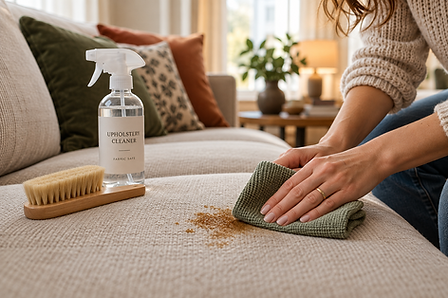
Knowing your upholstery cleaning code is one of the simplest ways to protect your furniture and keep your fabric looking beautiful longer.
And if your furniture is ready for more than a cleaning, Novik Upholstery and Restoration (NUR) can help with reupholstery, fabric selection, cushion replacement, furniture restoration, and protective fabric treatments.
Love your furniture. Know your fabric. And always check the tag before reaching for the spray bottle.

bottom of page